
GATC Health Publishes a Multi-Omics Exosome Study Defining a New Therapeutic Path in Diabetes
May 11, 2026 — GATC Health is announcing the publication of “The Multi-Omics Profiling of Early-Passage Mesenchymal Stem Cell Exosomes Reveals Potential Targets for Attenuating Diabetic Inflammatory Pathophysiology,” now published in the American Journal of Biomedical Science & Research. The paper presents a multi-omics analysis of mesenchymal stem cell-derived exosomes and identifies a biologically differentiated, early-passage exosome profile with potential relevance for diabetes therapy. Authors include GATC’s Samuel Kho, Lukeman Kharrat, Waldemar Lernhardt, Eric J Mathur, Jayson Uffens, Ian Jenkins, and contributing author Jonathan RT Lakey.
The publication also reflects the same systems-level scientific logic that underpins Operon™, GATC Health’s proprietary, AI-powered discovery engine, where predictive intelligence meets collaborative innovation, using integrated biological data to distinguish signal from noise, identify therapeutically meaningful patterns, and generate more actionable development hypotheses. In this case, that framework was applied to exosome biology, where multi-omics profiling and latent-factor modeling were used to separate regenerative, anti-inflammatory signatures from senescence-associated inflammatory drift.
The core finding is clear: early-passage MSC-derived exosomes carry a distinct anti-inflammatory, cytoprotective, and homeostatic signature, in contrast to late-passage secretomes, which were associated with a pro-inflammatory senescence-associated secretory phenotype (SASP). Using proteomics, lipidomics, metabolomics, and Multi-Omics Factor Analysis (MOFA), the study identified early-passage exosomes as a biologically favorable population enriched for molecules that may mitigate β-cell injury, immune dysregulation, and metabolic dysfunction in diabetes.
This is strategically important because it moves the discussion beyond general interest in stem-cell-derived exosomes and into mechanistic, data-rich therapeutic design. The paper shows how integrated multi-omics can distinguish between regenerative and inflammatory vesicle populations, identify inverse relationships with diabetes-related molecular signatures, and define a more disciplined framework for evaluating exosome-based interventions. It also underscores a critical practical point: passage stage matters. Early-passage material appears biologically advantaged; late-passage material may be counterproductive.
For GATC, the publication reinforces a broader point about the company’s platform and scientific posture. This is not just about one therapeutic modality, but about applying multi-omics reasoning and systems-level analysis to identify which biological signals are worth advancing, and which are not. In this study, that approach yielded a clear translational thesis: early-passage MSC-derived exosomes warrant serious consideration as a promising, scalable option in the development of diabetes therapies.
GATC continues to publish work that sharpens the industry’s understanding of how complex biological systems can be interrogated, stratified, and translated into more actionable therapeutic strategies. This paper extends that leadership into cell-free regenerative therapeutics, with diabetes as the proving ground.
About GATC
GATC Health is a tech-bio company revolutionizing drug discovery and development by simulating complex human biology to predict how drugs will perform in the body, achieving 91% specificity and 86% sensitivity. Trusted by the world’s largest insurance marketplace, biopharma, researchers, and investment partners, GATC Health’s risk prediction product, the Derisq™ AI report, accurately assesses and predicts drug candidate safety, efficacy, and non-obvious side effects prior to the commitment of development capital. GATC Health’s AI platform is also generative, creating novel intellectual property, extending pipelines, and optimizing assets. By uniting advanced AI, multiomics, and predictive modeling, GATC Health accelerates breakthroughs and reduces costly late-stage failures to bring safer, more effective therapies to patients worldwide. For more information, visit www.gatchealth.com.
Contact Us
Similar News
GATC Health Continues to Receive Strong Media Attention
February 10, 2026 – GATC Health received coverage in three leading industry publications last week. On Tuesday, GATC Health’s Preside…
Read more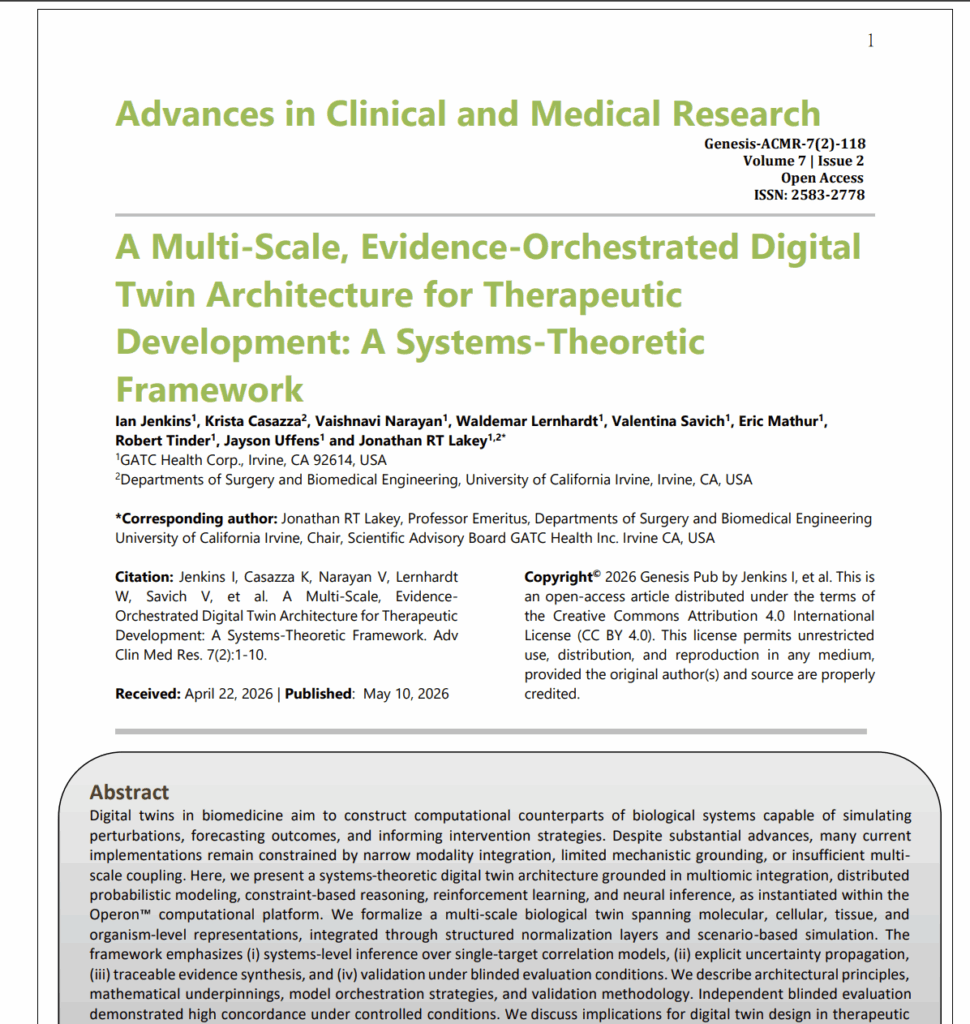
GATC Health Publishes a Digital Twin Framework for Therapeutic Development
May 8, 2026 — GATC Health has announced the publication of “A Multi-Scale, Evidence-Orchestrated Digital Twin Architecture for Therapeutic …
Read more
GATC Health’s Chief Business Officer Featured on Empowered Patient Podcast, Highlighting AI-Driven Transformation of Drug Development and Clinical Trial Financing
March 18, 2023 — GATC Health, a technology company dedicated to de-risking and accelerating drug discovery and development, announced today…
Read more